Architecture
The CAS Reference Product implements a robust boundary for the Coding Autopilot System, designed for deployment within an Azure Container Apps environment. The application uses a strictly typed schema for interactions, adopting canonical cas-contracts data structures.
System Architecture
The following diagram visualizes the primary request flow and components within the application:
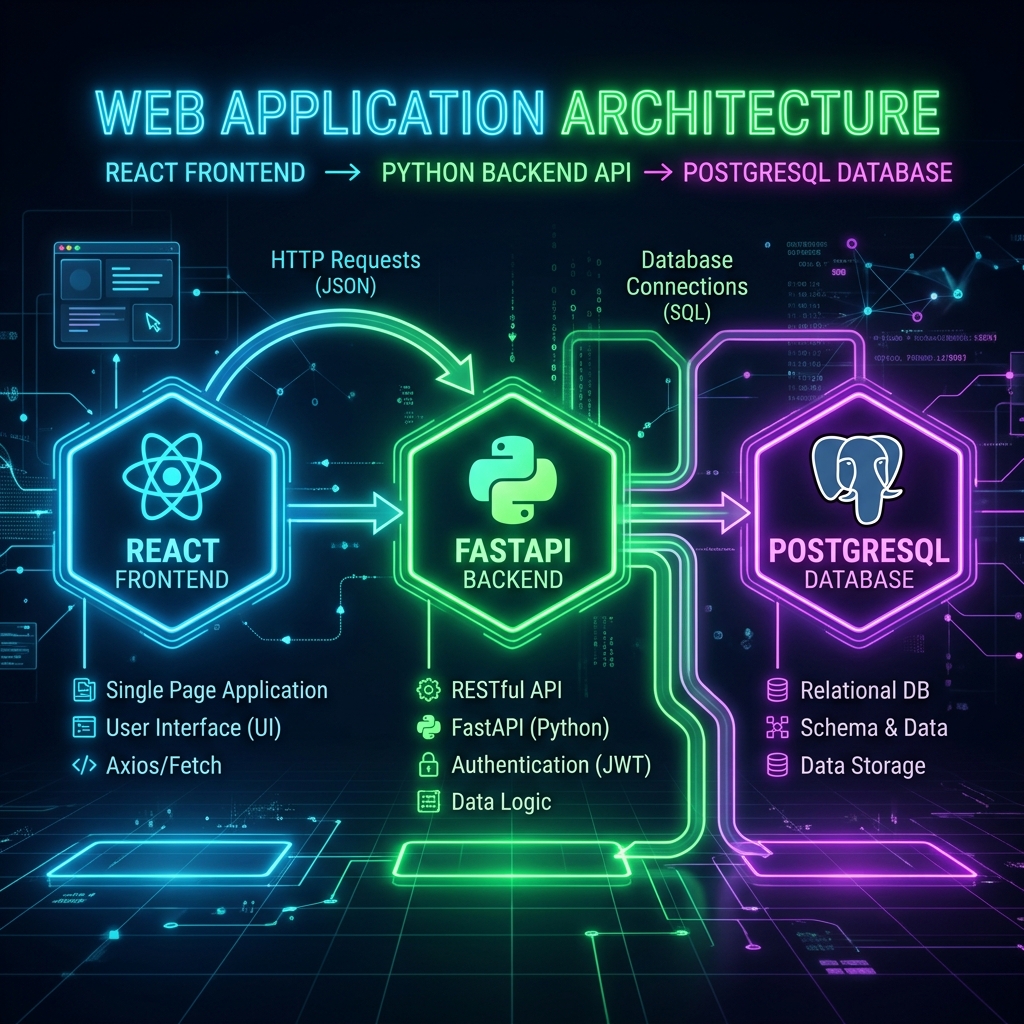
flowchart TD
    Client[Client] -->|POST /api/v1/workflows\nPromptEnvelope| FastAPI[FastAPI Server\napp.py]

    subgraph Core Application
        FastAPI --> Middleware[W3CTraceContextMiddleware\ntelemetry.py]
        Middleware --> Router[Workflow Router]
        Router --> Orchestrator[WorkflowOrchestrator\nworkflow.py]

        Orchestrator -->|Start Event| EventGen[RunEvent Generator\nmodels.py]
        Orchestrator --> AgentService{WorkflowAgentService\nworkflow.py}

        AgentService -->|Local Config| LocalAgent[LocalWorkflowAgentService]
        AgentService -->|Foundry Config| FoundryAgent[FoundryWorkflowAgentService]
    end

    subgraph External Infrastructure
        FoundryAgent -->|Managed Identity| AzureAuth[Azure DefaultAzureCredential\nidentity.py]
        AzureAuth -->|Responses API| AzureAI[Azure AI Projects API]
        AzureAI -->|Invoke Agent| FoundryNextGen[Foundry Next Gen Agent]
    end

    LocalAgent -->|Deterministic Output| Orchestrator
    FoundryAgent -->|Agent Output| Orchestrator

    Orchestrator -->|Complete Event| EventGen
    EventGen -->|WorkflowResult\nRunEvent| Router
    Router -->|200 OK| Client

    style FastAPI fill:#0a5c43,stroke:#fff,color:#fff
    style Orchestrator fill:#2d3748,stroke:#fff,color:#fff
    style AgentService fill:#b3531b,stroke:#fff,color:#fff
    style FoundryNextGen fill:#0d6efd,stroke:#fff,color:#fff
Component Breakdown
- FastAPI Web Layer (
app.py): - Exposes
/api/v1/workflowsfor execution. - Provides
/health/liveand/health/readyfor Kubernetes/Container Apps probes. -
Manages OpenTelemetry spans, tracking request context via
PromptEnvelope.correlationId. -
Telemetry (
telemetry.py): -
W3CTraceContextMiddlewareensures trace headers (traceparent,tracestate) are parsed and propagated properly across distributed systems. -
Workflow Orchestrator (
workflow.py): - Wraps the execution of the agent.
- Emits canonical
RunEventdata points (e.g.,workflow.started,workflow.completed,workflow.failed). -
Packages the final execution into a
WorkflowResult. -
Workflow Agent Service (
workflow.py): - The application boundary for AI logic.
- Local Mode: Bypasses the cloud entirely. Returns a deterministic output confirming the intake of constraints and intents. Useful for integration testing.
-
Foundry Mode: Uses
AIProjectClientto invoke a designated Foundry Next Gen agent using the Responses API. -
Data Models (
models.py): - Strongly typed Pydantic models.
-
Requires explicit non-null values, enforcing high-quality data across boundaries (e.g.,
PromptEnvelope,RunEvent,Actor,TraceContext). -
Identity (
identity.py): - Uses
DefaultAzureCredentialfor local development or system-assignedManagedIdentityCredentialin Azure. - Follows security best practices by strictly avoiding hardcoded secrets or API keys.
Deployment Strategy
The application is meant to be packaged as a Docker container, running rootless. It's built for the cas-platform ecosystem, which dictates the Azure resources, network topology, and Managed Identity mappings externally.